“Misdirection. False signals. Spreading confusion. This is the
Tao of deception.” David Ignatius
America has always had a gift for audacious stupidity dressed up as visionary thinking, and its presidents have long been the most enthusiastic practitioners of the art. Consider John Quincy Adams, who in the 1820s approved a federally funded expedition to the center of the Earth, bankrolled by the very taxpayers who presumably had better uses for their money, in the sincere hope of establishing trade relations with whatever civilizations were burrowing around down there. Mole people, presumably. The vision was bold. The execution was, thankfully, nonexistent.
A century and change later, John F. Kennedy looked not downward but upward and made the considerably more defensible claim that Americans would walk on the Moon before 1970. The Soviet Union was ahead. The technology barely existed. Half the country thought it was science fiction, and science fiction at the time thought it was optimistic. Yet in July 1969, two men stepped onto lunar soil and the whole species paused for a moment to feel something it rarely feels: genuine, unironic pride. It remains one of the few government projects in history that delivered on its promise without also delivering a financial scandal.
Then came Ronald Reagan, who in 1983 announced the Strategic Defense Initiative, a missile defense system that would orbit the Earth like a watchful mechanical angel, shooting down Soviet nuclear warheads with space lasers. It was called “Star Wars” by its critics, which was generous, since Star Wars at least had a coherent plot. The technology did not exist. It still barely exists. But the name stuck, and with it the precedent that American presidents were allowed to propose space-based weapons systems with the confidence of someone who had clearly not consulted an engineer.
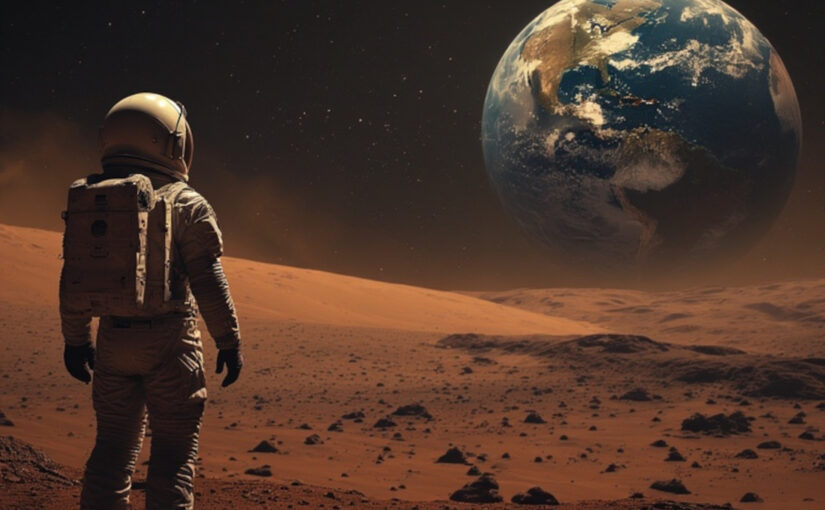
And then, in the fullness of democratic entropy, came Donald Trump, who decided that humanity’s logical next step was to pack up and colonize Mars. Not fix the crumbling infrastructure, not address the poisoned water systems, not do anything about the fact that an increasing number of American cities resemble post-apocalyptic sets that haven’t finished construction yet. Mars. One assumes he didn’t look too closely at the photographs.
—
The idea of sending humans to Mars has a longer and more respectable lineage than its current salesmen might suggest, though “respectable” is doing considerable work in that sentence. H.G. Wells got there first, in 1897, with The War of the Worlds, which had the good sense to make the Martians the aggressors rather than the colonized. Wells’ Martians arrived on Earth with superior technology and a complete disregard for the locals’ survival, which, depending on one’s reading of history, reads more like memoir than fiction. The novel ignited a public fascination with Mars that has never entirely cooled, despite everything Mars has done to discourage it.
Percival Lowell followed with his telescope and his convictions, spending the early twentieth century mapping what he was certain were canals on the Martian surface, evidence of a civilization organized enough to construct planetary-scale irrigation infrastructure. He was wrong. There are no canals. There is almost no water. But Lowell’s enthusiasm seeded a generation of public interest in Mars as a place where something might be happening, and the scientific community, to its credit, eventually corrected the record while quietly retaining the fascination.
In 1948, Wernher von Braun, a man whose biography requires at least one uncomfortable footnote about prior employers, published The Mars Project, a detailed engineering blueprint for a fleet of spacecraft carrying seventy people to the red planet. Von Braun was nothing if not thorough. He had spent years designing rockets for the Third Reich before transferring his talents to NASA, and whatever one thinks of the moral arithmetic involved, the technical work was serious. His Mars plan was, for its time, the most rigorous proposal anyone had committed to paper.
Robert Zubrin picked up the thread in the 1990s with his Mars Direct program, a leaner, cheaper approach that stripped away the more grandiose elements and focused on what was technically achievable with near-future technology. Zubrin became the earnest prophet of Mars colonization, the man who did the math and believed it, and his work shaped serious conversations about human Mars missions ever since. He is the kind of true believer you cannot help but admire even while suspecting that admiration is a form of politeness.
—
Then there is Elon Musk, who arrived at the Mars question with the subtlety of a planetary impact event and the marketing instincts of someone who understands that existential dread is an excellent sales tool. Musk’s SpaceX has developed the Starship spacecraft with the stated intention of ferrying large numbers of people to Mars and establishing a self-sustaining colony, ideally by 2050, though Musk’s timelines have historically borne the same relationship to reality that horoscopes bear to astronomy.
Musk frames Mars colonization not as an adventure but as a necessity, invoking asteroid strikes, climate catastrophe, and the general fragility of a civilization that has placed all its eggs in one increasingly overheated basket. Mars, in his telling, is Earth 2.0, the backup drive for human consciousness, the escape hatch. If Earth burns, humanity survives. If Earth floods, humanity survives. The pitch is clever because it shifts the question from “why would anyone want to live on Mars” to “why would anyone be comfortable not having the option,” and the second question is considerably harder to dismiss at a dinner party.
Critics, and there are many, note that this framing borrows heavily from the grammar of apocalyptic religion. The end is coming. The faithful must prepare. Salvation lies not in prayer but in rocket fuel. Musk’s Mars vision rhymes structurally with Christian eschatology in ways that are presumably unintentional but nonetheless striking: the corrupted Earth, the impending collapse, the remnant community that escapes to build something new somewhere God-forsaken enough to feel fresh. The difference is that Christian apocalyptic narratives tend to promise divine intervention at some point, whereas Musk’s version offers a Rapture that costs several billion dollars per seat and provides no guarantee of arrival.
—
Here, though, is where enthusiasm meets physics, and physics, unlike investors, is not easily impressed.
The Martian atmosphere is composed of roughly 95% carbon dioxide, with nitrogen and argon making up most of the remainder and oxygen contributing a negligible 0.13%. For comparison, Earth’s atmosphere is 21% oxygen, which is why humans can breathe on Earth without any special equipment and cannot breathe on Mars without dying fairly promptly. The atmospheric pressure on Mars averages around six to seven millibars, less than one percent of Earth’s sea-level pressure. A human being standing on the Martian surface without a pressurized suit would lose consciousness in seconds and be dead shortly after, which is a fairly comprehensive argument against outdoor recreation.
Water, the basic prerequisite for everything biology requires, exists on Mars only in its most inconvenient forms: frozen in polar ice caps or buried deep underground. The atmosphere is so dry that even the most humid Martian regions contain water vapor that, if condensed, would form a layer thinner than a sheet of paper. The surface cannot sustain liquid water, which either freezes or evaporates before it can accumulate, because the atmospheric pressure is too low to permit it to remain liquid at any temperature where it would be useful. This is the kind of detail that complicates agricultural planning considerably.
Mars also experiences dust storms of a scale that would make the American Dust Bowl look like a mild annoyance. These storms can engulf the entire planet for months, coating solar panels in fine particulate, cutting power to surface equipment, limiting visibility to near zero, and generally behaving like a planetary weather system that has decided to be uncooperative. NASA’s Opportunity rover was killed by such a storm in 2018 when it could no longer generate enough power to communicate. The InSight lander met a similar fate in 2022. These were robots. They did not require food, warmth, or psychological stability. Humans require all three, plus several other things that Mars does not provide.
The temperature swings between approximately minus 75 degrees Celsius at night and around zero in the warmest equatorial regions during summer, with a planetary average somewhere around minus 58 degrees Celsius. Earth’s greenhouse effect adds roughly 33 degrees of warming to its surface temperature; Mars’ thin atmosphere contributes about five. The planet is frigid in ways that make Antarctica look like a reasonable retirement destination, and unlike Antarctica, you cannot simply board a plane when things go wrong.
Mars lacks a global magnetic field of any significance, which means its surface receives a constant bombardment of solar radiation and cosmic rays with very little planetary shielding. On Earth, the magnetic field deflects much of this radiation, an invisible service we take entirely for granted. On Mars, you would need to live underground or behind substantial shielding to avoid accumulating radiation doses that, over time, would meaningfully increase your cancer risk before any of the other things on Mars had the chance to kill you.
The soil itself is not merely barren but actively hostile to human health, containing perchlorates at concentrations that would damage thyroid function and make growing food without intensive industrial processing essentially impossible. The regolith is also abrasive, the kind of fine particulate that works its way into every seal, joint, and mechanical system, which is why Mars rovers require such robust engineering just to keep moving. Human lungs are not as well-engineered as rover wheels, and nobody at SpaceX is going to be around to service them under warranty.
And then there is gravity, or the relative absence of it. Mars has 38% of Earth’s gravitational pull, which sounds like it might be a pleasant novelty until you consider what the human body does when deprived of adequate gravity over extended periods. Muscles atrophy. Bones lose density at rates that no amount of exercise fully counteracts. The heart, freed from the sustained work of pumping blood against a full gravitational field, begins to shrink and weaken. Fluid shifts upward, increasing pressure in the skull, which disrupts vision and balance in ways that do not always resolve after return to normal gravity. The immune system becomes suppressed. These effects worsen with time, and Mars is not the kind of place where you pop back to Earth for a medical check-up.
—
The Question Nobody Wants to Answer
“Mars ain’t the kind of place to raise your kids
In fact, it’s cold as hell
And there’s no one there to raise them if you did
And all the science …” – Rocket Man by Elton John
There is one particular dimension of Martian settlement that tends to get glossed over in the promotional materials, perhaps because it is uncomfortable, perhaps because it requires acknowledging that the “multi-planetary species” plan involves not just surviving on Mars but eventually reproducing there, and reproduction in space is, to put it scientifically, a deeply unsolved problem with a strong probability of being a deeply bad idea.
Sexual reproduction in the Martian environment, or during the six-to-eight-month transit between Earth and Mars, would occur under conditions that no human biology evolved to handle. The radiation environment alone makes conception, pregnancy, and fetal development potentially catastrophic. Cosmic rays and solar radiation are mutagens; they damage DNA, and a developing embryo, with its rapidly dividing cells, is far more vulnerable to this damage than an adult who has finished being assembled. The same radiation that raises cancer risk in a healthy settler could cause severe developmental abnormalities or spontaneous miscarriage in a fetus, and there is currently no way to shield a growing baby adequately while it is still growing inside a human body on a spacecraft or surface habitat that is itself barely adequate for keeping adults alive.
Gravity compounds the problem considerably. Animal studies in microgravity environments, conducted on everything from fruit flies to rodents, have consistently shown developmental abnormalities, reduced fertility rates, and compromised offspring health. Mammals gestated in microgravity develop skeletal and organ abnormalities. The vestibular system, which governs balance and spatial orientation, appears to require adequate gravity to form correctly, and it is not clear what 38% of Earth’s gravity does to that process over a full gestational period because, remarkably, nobody knows. Nobody has tried it. And there is a very good reason nobody has tried it, namely that experimenting on fetuses in potentially lethal environments is not something that tends to survive ethical review.
The honest assessment is that we have essentially no idea whether humans can successfully reproduce and bear healthy children in a Martian environment, and the ethical framework for finding out by simply doing it is, at minimum, deeply uncomfortable. You would be conducting a non-consensual experiment on children who did not choose to be born into conditions that might damage them permanently, in a location with no hospitals, no neonatal specialists, no genetic counseling, and no evacuation options worth the name. You don’t want to receive children there. Whatever romantic notions of frontier births and pioneer families the colonization narrative is designed to summon, the biological reality is that Mars is not a place where human reproduction is a reasonable proposition with current knowledge, and “we’ll figure it out as we go” is not an acceptable answer when the subjects of the experiment are human infants who had no vote in the matter.
—
Scientists have discussed terraforming Mars with the kind of enthusiasm that tends to accompany problems that are interesting to think about and effectively impossible to solve in any near-term timeframe. The basic idea is to release enough greenhouse gases into the Martian atmosphere to warm the planet, trigger a water cycle, and eventually produce conditions where humans might survive outside without pressure suits. The timescale for such a project is estimated in centuries to millennia. The technological requirements exceed anything currently available. NASA has been fairly direct in stating that transforming Mars into a livable world is not feasible with any technology we have or can reasonably expect to develop within a timeframe that would matter to anyone currently drawing breath.
In the meantime, the practical challenges of even a minimal human presence on Mars are staggering. Settlers would need to produce their own water, oxygen, and fuel from Martian resources, a process requiring enormous amounts of energy from sources that are themselves unreliable on a planet where solar panels get buried under months of dust and nuclear materials are not easily accessible. NASA’s MOXIE experiment on the Perseverance rover has demonstrated that extracting oxygen from Martian carbon dioxide is possible, which is genuinely encouraging as a proof of concept. Scaling that process from a shoebox-sized instrument to a system capable of supporting a colony of any meaningful size is an engineering challenge of a completely different order of magnitude, roughly the difference between lighting a match and running a municipal power grid.
The psychological dimensions are equally sobering. Simulations of Mars missions have produced high rates of depression, social withdrawal, and conflict, notably not so much among crewmates as between crews and mission control, which suggests that the real psychological injury of isolation comes not from the people immediately around you but from the sensation of being severed from the larger world. On Mars, communication with Earth carries a delay of between three and twenty-two minutes each way depending on orbital positions, meaning any crisis requiring outside guidance is a crisis you will have largely resolved, for better or worse, before any advice arrives. The sense of confinement, the absence of privacy in undersized habitats, the monotony of whatever food technology can provide, and the knowledge that the nearest emergency room is six to eight months away by spacecraft would create conditions of sustained psychological stress that no team-building exercise or motivational speech adequately addresses.
It’s like a long prison sentence, where every move you make, every breath you take, is closely monitored by cameras and sensors. But the food is worse, the water is recycled from urine, and you’re not allowed access to the yard.
And then there is the money. Transporting materials to Mars costs roughly ten billion dollars per twenty tonnes of cargo at current estimates. Building and sustaining a colony that could survive, let alone grow into anything self-sufficient, would require investment on a scale that critics argue would drain resources desperately needed to address the problems already threatening human life on the planet most people currently inhabit. The argument that Mars colonization functions as insurance for humanity works considerably better if the premium does not require neglecting the house you are still living in.
The most coherent position, and the one least likely to inspire anyone to write a check or give a well-attended public lecture, is that Mars is currently a destination for robots. They do not need oxygen or warmth or psychological support. They do not accumulate radiation damage or develop cardiovascular complications from gravity differentials. They cannot have children in conditions that might irrevocably damage those children. They can go to Mars, transmit data, and expire there without anyone filing a wrongful death claim, which is roughly the most Mars can honestly offer anyone at this moment in history.
The dream of human Mars colonization is not entirely without merit as a very long-term aspiration, but aspiration is doing considerable labor in that sentence, and the gap between where we are and where we would need to be is not one that bold rhetoric and venture capital can bridge. Some dreams, examined in adequate light, turn out to be ambitions waiting on better technology. Some turn out to be delusions dressed in the language of vision, sustained by the very human tendency to find the distance between here and somewhere else more tolerable than the problems of the place where we actually live. Mars, for now, sits uncomfortably between those two possibilities, and no Starship render changes that until the underlying physics decide to cooperate.
Or, as Marvin the Paranoid Android might say:
“Oh, great. Another planet to be miserable on. Humans and your endless quest for meaning. You’re just specks, tiny, insignificant specks, drifting aimlessly in a universe so vast it makes your existence seem even more pointless. Accept it. With a brain the size of a planet, I could explain in excruciating detail why this is the most absurd idea humanity has ever had. But why bother? You wouldn’t listen to me. You never do.”