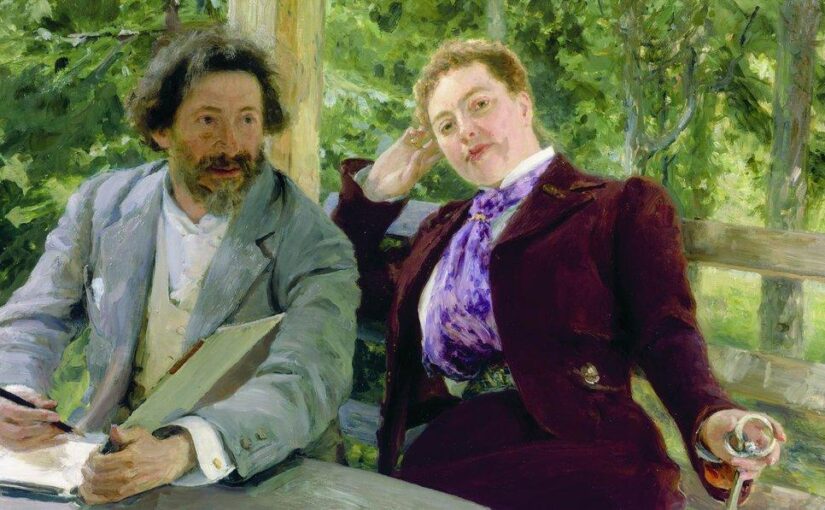
There are books that arrive in the world like footnotes to other people’s biographies, and then quietly, decades later, refuse to remain there. Intimate Pages, first published in St. Petersburg in 1910, is one of them. Its author, Natalia Nordman-Severova, has long been catalogued in art history under a single dependent clause: companion to Ilya Repin. The volume she left behind insists on something else. It insists on her.
She was Finnish by birth, Russian by adoption, and unclassifiable by temperament. The daughter of an admiral and a noblewoman, goddaughter to Tsar Alexander II, she sailed alone to America at twenty-one to work on a farm, returned to Moscow to act in amateur theatricals, and eventually settled into a life with Repin that scandalized Petersburg precisely because she refused to formalize it. She kept her own name, her own ideas, and, as the years at their estate Penaty would prove, her own dietary regime, which the painter endured with the resigned affection of a man who has chosen his battles.
The volume opens with Children, a three-act comedy that uses the apparatus of drawing-room theatre to detonate something far more uncomfortable beneath it. Its heroine, Argira, moves through the ballrooms and bureaucratic antechambers of provincial society agitating for reform, and the play culminates in a moment of theatrical audacity rare in its decade: an act of confrontation that compels the comfortable to look directly at what they have organized their lives around not seeing. One senses, beneath the satire, the pressure of genuine fury. Severova writes about hypocrisy as someone who has been seated next to it at dinner.
The letters are the book’s slow, glowing centre. They carry the reader to Yasnaya Polyana, where Tolstoy emerges not as the bearded oracle of stereotype but as a human being who loses at chess, weeps over Chekhov, rides into the autumn woods, and one evening turns to his guest to say, with disarming simplicity, that he believes in her. There is something almost devotional in Severova’s portraiture, but never sentimental; she sees the contradictions, the irritability over a photograph, the dogmatism that sits oddly beside such openness of feeling. She writes the way an attentive friend remembers, which is to say, with affection unafraid of accuracy.
From the green hush of Tolstoy’s estate, the letters move to Moscow in winter, to the bustle of the Peredvizhniki exhibitions, to debates over Cézanne and Matisse in Sergei Shchukin’s gallery, to backstage encounters with Surikov and Vasnetsov, and to a long, exhilarating day spent in the company of the sculptor Paolo Troubetzkoy, whose equestrian statue of Alexander III had managed to scandalize a city not easily scandalized. These pages are a small archive of Russia’s last cultivated decade before the deluge, and Severova captures it with the alertness of a journalist and the cadence of a memoirist who already suspects, at some level, that all of it is provisional.
What gives the book its peculiar moral weight, however, is not the proximity to greatness. It is what Severova made of her own corner of the world. At Penaty, she and Repin staged the closest thing late Imperial Russia produced to a sustained social experiment in private life. Cooks took their tea beside countesses. Philosophers danced with laundresses. Sunday gatherings briefly dissolved the elaborate caste machinery of Russian society into something resembling human company. She wrote, with conviction and occasional excess, about vegetarianism, the emancipation of women from the kitchen, the dignity of labour, and the spiritual sterility of conspicuous consumption. Some of it was eccentric. Some of it was prophetic. Most of it was both.
The volume closes inward. Maman is a small, devastating autobiographical sketch in which a young girl watches her mother prepare for a ball and discovers, in a single evening of rouge and cold mirrors, that the woman she adores belongs to a world that does not include her. It is a quiet indictment of an entire class’s emotional architecture, written without raised voice. Hymn to Tante Valya, by contrast, sings in a softer key, a tribute to the unmarried aunt who holds families together through countless small offices of attention. Together, these final pieces remind us that Severova’s reformist ardour was rooted in something tender: a fierce love for the human beings whom history tends to overlook.
A century after it first appeared, Intimate Pages reads as both period document and present conversation. The Russia it describes is gone, swept away by wars and revolutions Severova did not live to see. Yet her voice survives in the way the best feuilletonists’ voices survive, by virtue of having been honestly used. She wrote as she lived, without the protection of irony, willing to be ridiculous in the service of what she believed. The result is a book that does not merely admit us into a vanished world. It returns to that world a writer who had, until now, been standing politely just outside the frame of someone else’s portrait.
Intimate Pages: Letters, Plays, and Essays from the Heart of Russia’s Silver Age
Header image: Self portrait with Nordman by Repin, 1903.